
Obreal and ASCUN open a new chapter in the Colombian university system’s international engagement
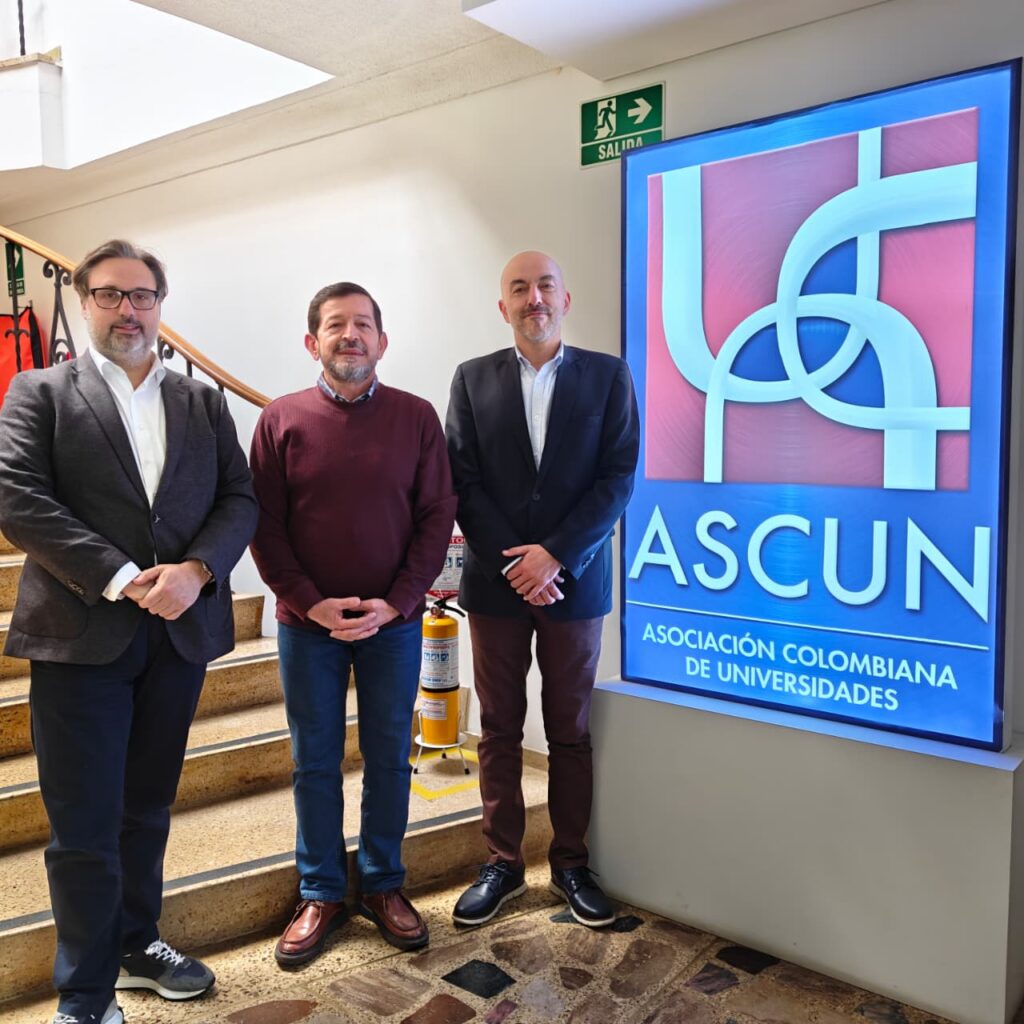
Obreal was present in the Expanded Executive Council meeting of the Colombian Association of Universities (ASCUN). The meeting provided an opportunity to review a relationship built over almost two decades and, above all, to discuss its next phase. The aim is no longer simply to expand joint projects, but to strengthen the Colombian university system’s capacity to build international relationships based on its own priorities and extend its reach to other regions.
The discussion starts from a simple observation. In a more fragmented and polycentric international order, the internationalization of higher education cannot be reduced to mobility, calls for proposals or participation in programs designed outside the region. Universities produce knowledge, develop capacities, build partnerships and connect societies. They are also actors in international relations.
The relationship between ASCUN and Obreal provides a solid foundation for moving in this direction. Direct cooperation began in 2008, although Obreal’s ties with Colombia date back to its founding, in which the Universidad de los Andes participated in 2004. Since then, the relationship has encompassed international projects, institutional capacity building and spaces for policy dialogue. Today, ten Colombian institutions are members of Obreal, 38 universities affiliated with ASCUN have participated in the organization’s projects or programs and Obreal has worked, through various frameworks, with 95 higher education institutions in the country.
The Third Interregional Dialogue on Education and Development, held in Bogotá in November 2025, marked a turning point. Colombia did more than host the event. Its university and scientific system took on a more visible role in a conversation connecting Latin America and the Caribbean with Africa, Europe, the Arab world and Asia.
That conversation will continue from December 13 to 17, 2026 in Addis Ababa, where the fourth edition of the Interregional Dialogue will take place at the African Union headquarters. Obreal and ASCUN are working to ensure that Colombian institutions play an active part in this new phase of the process.
An agenda looking ahead to 2027
The discussions in Bogotá also provided an opportunity to begin defining a joint agenda for 2027, the year of ASCUN’s 70th anniversary. Planned activities include institutional capacity building workshops for Colombian universities in Barranquilla, alongside opportunities for strategic reflection on higher education, internationalization and interregional cooperation.
The choice of Barranquilla has particular significance. It allows part of this new agenda to develop from Colombia’s Caribbean region and reflects Obreal’s broader engagement with the Caribbean.
The Caribbean cannot be treated as a secondary extension of Latin America. Its linguistic diversity, history and institutional and university structures call for direct engagement in their own right. For Obreal, deepening this relationship means working directly with its universities, networks and institutions while also drawing on capacities already established elsewhere in the region.
In this respect, Obreal’s presence in Bogotá can take on a broader role. This is not about moving the center of a Caribbean agenda to Colombia, but about using a stable institutional presence to sustain relationships, support initiatives and provide more consistent connections among universities, territories and systems that have often worked in a fragmented way.
Barranquilla offers a concrete expression of this possibility. Strengthening the international capacities of Colombian universities from the Caribbean coast while opening new relationships with the wider Caribbean brings together two objectives that have so far tended to be addressed separately.
The Colombian university system’s regional engagement is also evident in other settings. In October, Obreal will participate alongside RCI-ASCUN in the International Conference of the Mexican Association for International Education, AMPEI, one of Mexico’s leading networks dedicated to the internationalization of higher education. Colombia will be the Guest Country of Honor at the 2026 edition, opening another space to expand its universities’ relationships with institutions and university systems across the region.
From cooperation to the capacity for international engagement
During the mission, Obreal also met with institutions from Colombia’s scientific, technological and university system and with partner universities. The aim was to identify new opportunities for cooperation and connect them with institutional and national priorities.
The direction emerging from these discussions demands more than a collection of international activities. It is about ensuring that projects, relationships and accumulated knowledge generate lasting institutional capacity and greater autonomy in engaging with the world.
This idea is central to Obreal’s new strategy. Obreal’s offices in Latin America and Africa do more than manage projects in individual countries. They are key to building connections, sustaining relationships over time and, above all, strengthening the capacity of institutions and regions to engage internationally.
In Colombia that foundation already exists. After more than two decades of work in the country and almost twenty years of direct cooperation with ASCUN, the challenge is not to establish a relationship. It is to take it to a new scale. To strengthen the international capacity of Colombian universities, support their engagement with other systems and turn the experience built in Colombia into a foundation from which Obreal can develop, among other relationships, a more sustained and ambitious partnership with the Caribbean.