
Tailored solutions for a shared challenge: rethinking higher education reform
Obreal participated in the Bologna Process Researchers’ Conference (BPRC) in Bucharest on 16- 17 September 2026, contributing to a discussion on how international cooperation can support higher education reform across different national and institutional contexts.
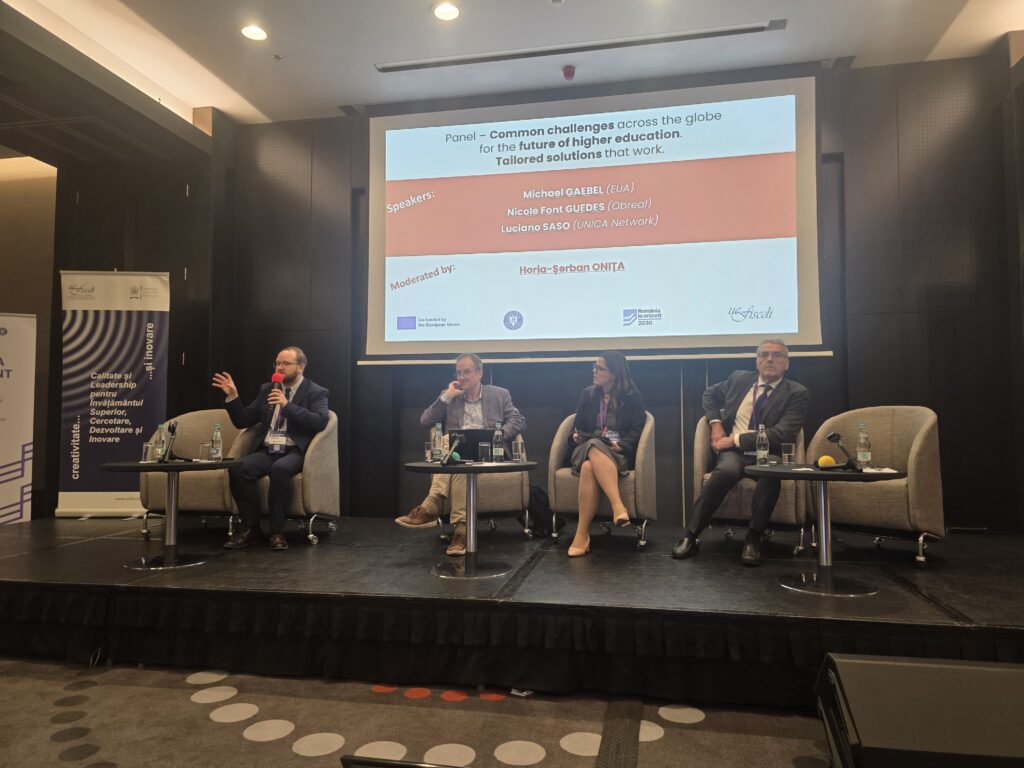
Nicole Font Guedes, Project Manager at Obreal and Key Expert in the SPHERE initiative, joined the panel “Common challenges for the future of higher education: Tailored solutions that work”, moderated by Horia Onița, Head of the EHEA Secretariat. The panel also included Michael Gaebel from the European University Association (EUA) and Luciano Saso, Secretary General of UNICA.
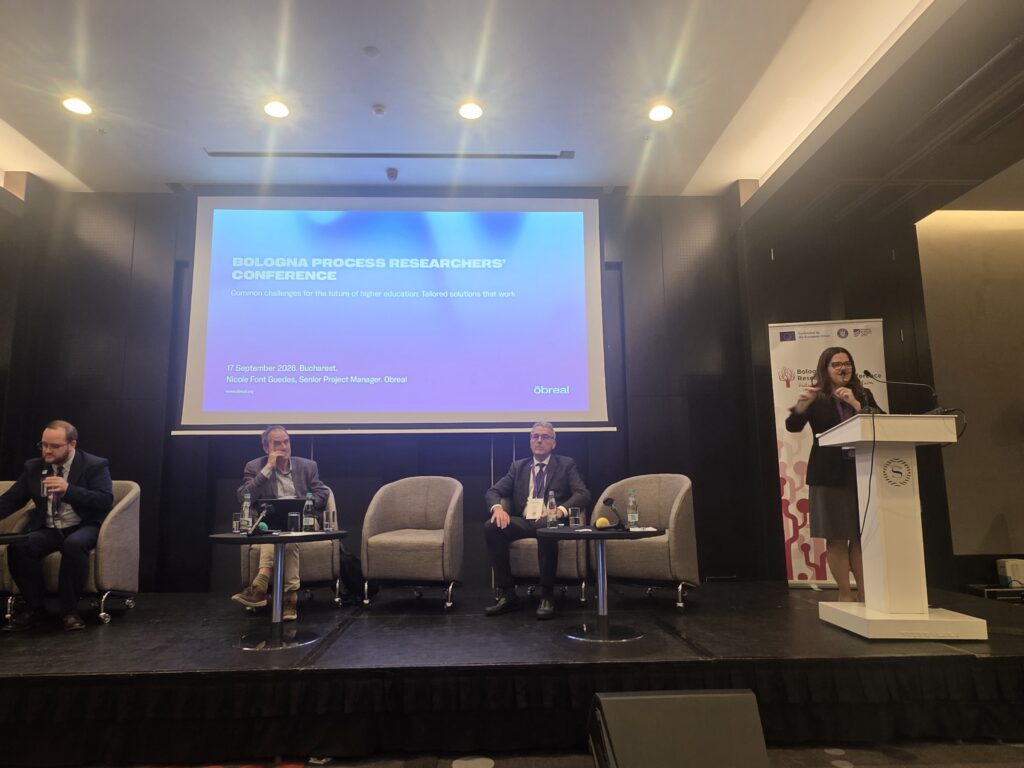
The discussion focused on a question that is increasingly important for international higher education cooperation: what makes an approach developed in one system useful in another? Rather than looking only at the transfer of policies or instruments, speakers reflected on the value of exchanging models and experiences while also understanding the conditions that make them work, including funding, regulation, institutional capacity and the actors involved in implementation.
The discussion connected directly with Obreal’s wider work in international and interregional cooperation across education, research, science and development. Much of this work focuses on bringing institutions and regional agendas into dialogue, identifying areas of common interest and turning exchange into concrete and sustained cooperation.
SPHERE’s contribution to the discussion
During the panel, Font Guedes drew particularly on the experience of SPHERE – Centralised Support to the Network of Higher Education Reform Experts, an initiative financed by the European Commission through the European Education and Culture Executive Agency (EACEA) and implemented by a consortium coordinated by Obreal in partnership with EUA.
SPHERE offers a particularly relevant example because it works across higher education systems in the Western Balkans, the Neighbourhood East, the Southern Mediterranean and Central Asia, including countries both within and outside the European Higher Education Area.
One of the points highlighted was the importance of exchanging models without separating them from the environment in which they operate. Study visits, for example, allow Higher Education Reform Experts to look not only at a successful institutional practice, but also at the funding arrangements, legal frameworks, institutional structures and stakeholder relationships that support it.
A broader approach to interregional cooperation
This perspective also reflects Obreal’s broader approach to interregional cooperation. Through the Interregional Dialogue on Education and Development, Obreal works with partners from Europe, Africa, Latin America and the Caribbean, the Arab region and beyond to identify where regional agendas can connect and where dialogue can lead to concrete cooperation, new instruments and longer-term institutional relationships.
Participation in the BPRC was an opportunity to bring this practical perspective into the European debate on the future of higher education cooperation: international exchange becomes particularly valuable when it allows institutions to understand not only what others are doing, but why it works, under which conditions, and which elements may be relevant to their own reform processes.
For Obreal, this capacity to connect experiences, institutions and regional agendas remains central to building cooperation that can move from exchange towards meaningful and sustained change.